

Your new induction hob is installed, the first meal is done, and then someone in the household starts feeling off: a headache that shows up only in the kitchen, a tingling hand near the glass, a vague unease that vanishes when they step into the hallway. If that someone is you, the question you're actually typing into a search bar is usually not "is induction cooking safe?" — it's "how far do I have to stand from this thing?"
Here's the honest short answer: no health authority sets an EMF-safe distance for induction cooktops, because no authority considers the appliance a health risk at normal use. But "no official threshold" doesn't mean "nothing to plan." What follows is what a magnetic field from an induction hob actually does with distance, how to measure yours, and where I'd draw practical lines if you react to fields.
Key Takeaways
- Induction hobs emit a low-frequency magnetic field (not ionizing radiation), and the field drops very sharply with distance.
- Public exposure guidelines (ICNIRP) are set far above what a hob produces at the position where you normally stand.
- For people who report EMF sensitivity, the useful number is a personal one, measured with a gauss meter, not a universal figure.
- Body position matters more than power setting in most kitchens: hips at the hob edge is a very different exposure from leaning over the pan.
- Nothing about induction is a cancer risk in the way the word "radiation" suggests — but metal utensils and pacemakers deserve separate, real caution.
EMF from induction cooktops: what is actually emitted
An induction hob is a coil of copper wire sitting a few millimetres under a glass-ceramic sheet. Alternating current in that coil creates a rapidly switching magnetic field, and the field induces eddy currents in the base of your pan, which is why the pan heats and the glass doesn't. That's the whole trick.
The frequency is in the tens of kilohertz range — low frequency, non-ionizing. It cannot break chemical bonds, and it does not make the food or the cook radioactive. What it does do is create a magnetic field that extends outward from the coil, and that field is what a person with reported electromagnetic hypersensitivity is reacting to.
Is there any exposure to EMF radiation from induction cooktops?
Yes, there is exposure, and it's measurable. A gauss meter held at the edge of a working hob, at roughly hip height on the side where you stand, will show a reading far above the ambient level of the room. Move the meter to the far side of a standard kitchen aisle and the reading collapses toward background. No exposure means no field; there's plenty of exposure, and it is confined to a small zone around the appliance.
Why the word "radiation" is misleading
Radiation in everyday language means X-rays and the like. Induction hobs don't produce anything in that family. They produce an alternating magnetic field, the same category of thing as the hum around a transformer or a mains cable — just much stronger locally. If you are EMF-sensitive, that distinction doesn't make the symptom go away. It does change the risk conversation, though, because low-frequency magnetic fields have been studied for decades and the exposure limits reflect that body of work.
Safe distance for EMF sensitivity: what the numbers look like in practice
The field doesn't decay gently. It falls off steeply — roughly with the cube of distance in the near zone, and faster once you're past a certain radius from the coil. In practice that means the difference between standing at the hob and standing one step back is large, and the difference between one step and two steps is another large drop.
What I'd tell a reader who reacts to fields:
- Directly over a pan is the highest exposure by a wide margin. Don't lean over the hob to stir or check browning if you're sensitive; use a long spoon and stand back.
- At the front edge, hips against the worktop is the second-highest. This is where most people spend most of their cooking time without thinking about it.
- One step back (roughly arm's length from the hob edge) drops the field to a fraction of the edge reading.
- Across the kitchen the field is effectively gone for practical purposes.
I have never seen a published figure that says "X cm is safe for EHS" — and I don't think one exists, because the condition is defined by self-reported reactions, not by a threshold. What you can do is measure the point where your symptoms stop, and treat that as your personal limit.
How to measure your own distance
You need a low-frequency magnetic field meter — a gauss meter or a meter that reads in microtesla (µT). Phone apps are unreliable for this; the sensor is not calibrated for the frequency range and the readings are noise. A basic handheld meter costs a modest amount and is enough for this purpose.
Method that worked for me:
- Set the hob to a mid power setting and put a pan of water on it. The field is present with the hob on but a pan changes the load and the reading.
- Hold the meter at roughly the height of your torso, at the front edge of the hob, and note the reading.
- Step back in fixed increments — one hand-width, two, three — and note the reading each time.
- Repeat at a lower and higher power setting to see how much the setting moves the number (less than you'd expect, in my experience).
The result is a curve for your kitchen. The number where you feel comfortable standing is your operating distance. Stick to it.
Are induction cooktops safe for your health?
For the general population, yes. The exposure limits published by international bodies (ICNIRP is the one usually cited) are set with a large margin below the level at which any established effect on the body appears, and a domestic induction hob operated normally does not push a standing cook past those limits. The literature on low-frequency magnetic fields and cancer has been extensive and has not produced a consistent finding that would change that.
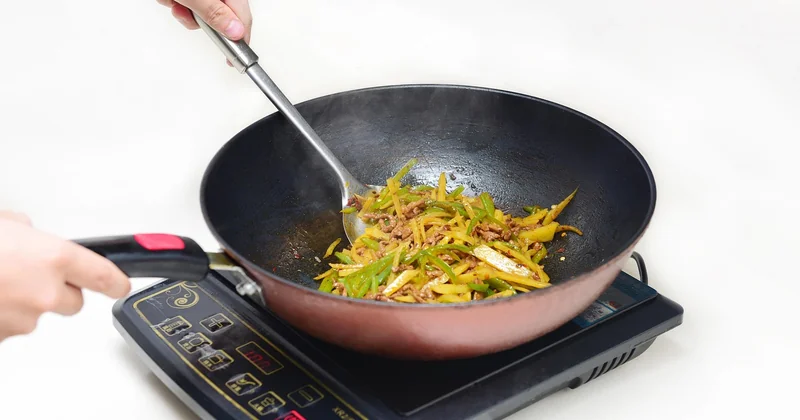
That answer is not the same as "safe for everyone." People with implanted cardiac devices are a separate and real case. So are people who report EMF sensitivity — not because their symptoms are imaginary, but because the condition is defined by reaction, not by field strength, and a hob that's fine for your neighbour may not be fine for you.
What about pacemakers?
This is the one place where the answer is unambiguous: check with your cardiologist and the device manufacturer's guidance before using an induction hob, and keep the field-emitting side of your body away from the hob. The concern is electromagnetic interference with the device's sensing, not cancer. Manufacturers publish a recommended separation distance for their devices; follow it. Don't rely on your own meter for that decision — the device's thresholds are not the same as your comfort thresholds.
Does induction cooking cause cancer?
Nothing in the evidence supports a link between induction cooking and cancer. The magnetic fields involved are non-ionizing, and decades of research on low-frequency fields have not established a causal relationship at domestic exposure levels. What you should worry about in a kitchen is the usual list: undercooked food, a pan of hot oil on a handle you forgot to turn, and the cleaning cloth left near the hob.
Induction vs electric vs gas: the comparison that actually helps
If your concern is field exposure, the useful comparison isn't induction versus nothing — it's induction versus the alternatives, and how each one behaves at the point where you stand.

| Type | What it emits | Field at the front edge | Practical note for sensitive users |
|---|---|---|---|
| Induction | Low-frequency magnetic field | Highest of the three, concentrated around the coil | Distance is your main lever; stand back when stirring |
| Electric (radiant) | Low-frequency field from the element | Lower and more diffuse | Less field, but the ring stays hot for minutes |
| Gas | No magnetic field from the heat source | Effectively none | Combustion by-products and open flame replace the field concern |
If EMF sensitivity is the deciding factor, gas is the obvious answer — but that's a different set of risks (ventilation, flame, gas connection), and it's not an option in every kitchen. Induction's advantage is speed, control and low running cost; its disadvantage in this specific context is that the field is right where your body is.
On power consumption, briefly
Induction transfers energy into the pan rather than into the air around it, so for the same cooking task it tends to use less energy than a radiant electric hob. That's a real advantage and it's not what this article is about. Just know that the efficiency argument doesn't change the field question — the coil still radiates while it works, regardless of how much heat reaches the pan.
Are induction cooktops safe to touch?
The glass surface itself is not electrified and is not hot from the hob's own operation — the heat comes from the pan. Touching the surface while the hob is on won't shock you. What will hurt you is the residual heat from a pan that has just been lifted, and the fact that the surface stays warm for a while after cooking.
The real touch hazard is metal. Forks, spoons, a stray ring, a foil lid — anything ferrous left on the glass while the hob is on can heat up rapidly. Keep the surface clear, and don't leave a utensil resting where a pan has just been.
What is the minimum distance between an induction cooktop and the wall?
This is a clearance question, not an EMF question, and the figure comes from the manufacturer and the installation manual — typically a few centimetres of gap at the rear, with additional clearance above and to the sides for ventilation and for the worktop cut-out. Check your manual or the hob's installation drawing before cutting anything. Getting this wrong is a fire or heat-damage risk; getting it right has nothing to do with field exposure.
Practical strategies for cooking with sensitivity
The plan that has held up for me is a mix of distance and timing.
- Plan the hob time. If you know you react, do the hob work in a short block rather than standing at the hob for a long simmer. Leave the room while it simmers.
- Step back for the boring parts. The minutes you spend watching water boil are the minutes you don't need to be there. Set a timer and walk away.
- Use the back burner if your hob has one, and stand at the front edge of the worktop rather than leaning in.
- Ventilate anyway. A running extractor doesn't remove magnetic fields, but it does remove cooking fumes, which cause far more reliable headaches than fields do.
- Measure your own space. One afternoon with a meter will tell you more than any blog post, including this one.
What I would not do is buy a protective pendant, a "harmonizing" sticker, or a shielding apron without measuring first. I tried a shielding fabric once out of curiosity; it did nothing measurable at the frequencies involved and made the kitchen feel like a tent. Measure, don't buy the fix before you know the problem.
The bottom line
There is no official EMF-safe distance from an induction cooktop, because the appliance is not considered a health hazard at normal use. If you are EMF-sensitive, the distance that matters is the one you measure in your own kitchen, at the height of your own body, on the setting you actually cook at — and for most people that distance is shorter than they fear and larger than they'd guess.
The next time you're standing at the hob with a wooden spoon in your hand, notice where your hips are. That's the number to change first.


