

Your landlord controls the wiring. Your neighbours control their routers. The building's roof might be hosting a cell antenna you never consented to. And you? You signed a lease and now want to sleep better at night.
That's the awkward reality of trying to reduce EMF exposure in a rental apartment. Everything the internet tells you to do — rip out wiring, paint the walls with shielding paint, install a demand switch — assumes you own the place. You don't.
So here's what actually works when you can't drill a hole without losing your deposit.
Key Takeaways
- You cannot eliminate EMF in a rental — you can lower your sleeping-zone exposure significantly with zero permanent changes.
- Distance beats shielding every time. Moving a bed 1.5 m away from a wall can cut radio-frequency power to a fraction of its original value.
- Measure first, buy later. A cheap RF meter tells you more in ten minutes than a hundred forum threads.
- Walls do not stop EMF. They weaken it. How much depends entirely on the material and the frequency.
- Aluminium foil is not a solution. It is a fire hazard wrapped in a folk myth.
Why rental apartments expose you more than houses
Shared walls are the obvious problem. But the bigger one is usually invisible.
In a typical apartment block, the electrical risers run vertically through the building, stacking meter after meter on the same column. If your bedroom shares a wall with the shaft that carries the neighbours' feeds, you're sitting next to a low-frequency magnetic field you have no control over.
The three sources you cannot remove
Think about what you actually own inside a rental:
- Your router and your devices — fully under your control.
- The building's wiring, meters and shared infrastructure — not yours. Sometimes negotiable, often not.
- Outside transmitters — rooftop cell sites, broadcast towers, a neighbour's Wi-Fi mesh on the other side of a 12 cm partition.
The first category is where most of your practical wins live. The second is a conversation with a landlord. The third is geometry.
Note that your exposure and your neighbour's 400 W router are not the same problem. In an apartment, the inverse-square law is your best friend and your worst enemy at the same time: a source three metres away delivers roughly one ninth the power density of the same source one metre away, but a source on the other side of a thin wall is a source you cannot switch off.
Measure before you buy anything
Every article about EMF tells you to buy shielding. Almost none tell you to measure first.
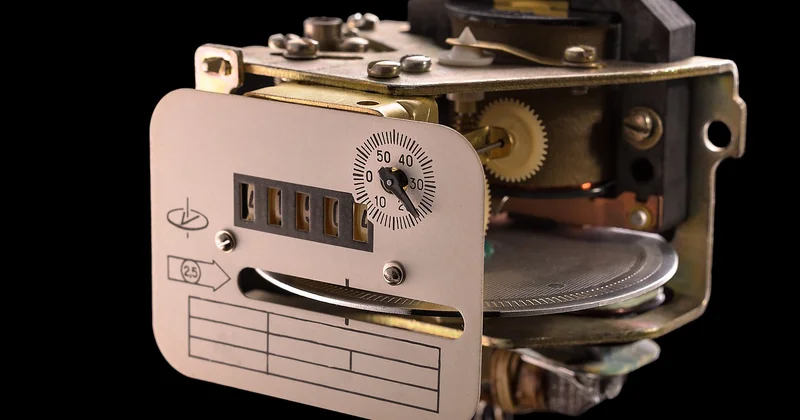
I'll be blunt: buying a shielding canopy or a "harmoniser" before you know where your hotspot is ranks among the most common mistakes people make in this space. You end up spending money on the wrong wall.
What a practical home measurement actually looks like
Two instruments cover nearly everything you need in a flat:
- A radio-frequency (RF) meter reading in µW/m² or V/m — for Wi-Fi, mobile signals, cordless phones, smart meters.
- A low-frequency (ELF) gaussmeter reading in milligauss (mG) — for wiring, transformers, meter boxes, appliances.
Cheap consumer meters are imperfect but adequate for relative comparisons: is this wall hotter than that one, is the reading higher at head height on the pillow than by the window. That's the question that matters.
How to map a room in ten minutes
Stand in the room, hold the meter at the height of your head while sleeping, and walk a grid. Take a reading roughly every half metre. Note the peaks.
Repeat at different times of day. A reading that spikes in the evening is probably a neighbour's router or a device stream. A reading that stays flat and high around the clock is probably building infrastructure — a riser, a meter cupboard, a transformer, or an external transmitter.
The number to watch is not the absolute value; it's the gradient. If the reading on your pillow is three times the reading at the door, you have a specific, solvable problem. If the whole room is uniformly high, you've learned something useful too: shielding part of it won't help much.
Distance is the only free fix that always works
Here's the thing most shielding product pages leave out: doubling the distance from a source reduces its power density by roughly a factor of four. No product on the market beats that, and distance costs nothing.

Rearranging a rental bedroom
Move the bed. That is the single highest-value action available to a tenant, and it involves no tools.
- Keep the headboard off shared walls where possible — especially a wall shared with a kitchen, meter cupboard or electrical shaft.
- Place the router in a hallway or living room, not in the bedroom. If you need coverage, run a cable and put an access point where you actually need it.
- Unplug the cordless phone base from the bedside socket. DECT bases transmit continuously.
- If you can, put the sleeping area at least a metre from any wall containing a meter box or riser.
I'll admit something: when I first moved into a flat above a shared riser, I rearranged the whole bedroom for a metre of clearance and felt slightly ridiculous doing it. But the gaussmeter reading at pillow height dropped by more than half.
Turning off what you own
Wireless gear is where you have total control. A phone in airplane mode at night, a router on a timer, Wi-Fi calling switched off — these changes are trivial and reversible, unlike anything involving the building.
For a wired setup, ethernet to a laptop or desktop removes one transmitting device from your body entirely. Many tenants never try it because they assume it means rewiring the flat. It doesn't. A flat cable under a rug works fine.
What blocks EMF best?
Materials that conduct electricity block radio-frequency fields best, and the effectiveness depends on the material, its thickness, and the frequency involved. Solid metal is the strongest practical barrier; dense masonry does something; drywall, wood and glass do very little.

In practice, the ranking for RF shielding looks roughly like this:
| Material | Effect on RF (Wi-Fi, mobile) | Effect on low-frequency fields |
|---|---|---|
| Solid metal sheet or foil (grounded) | Very high attenuation | Almost none |
| Metal mesh / window screen | High, frequency-dependent | Almost none |
| Conductive fabric or curtain | Moderate | Almost none |
| Concrete, brick | Low to moderate | Little |
| Drywall, wood, plasterboard | Negligible | Negligible |
Two important caveats. First, an ungrounded metal barrier can redirect a field rather than remove it, and in some cases concentrate it elsewhere. Second, shielding applied to only one wall changes where the field goes, not whether it exists.
What are the symptoms of high EMF exposure?
The commonly reported symptoms are headaches, fatigue, sleep disturbances, difficulty concentrating, and a feeling of "fog" that appears in specific locations and improves when the person leaves. It's worth being precise here: these reports come from people who describe themselves as electrically sensitive, and the evidence base is genuinely contested rather than settled.
What I would say as a practical matter: treat symptoms as a prompt to measure, not as a diagnosis. If you feel worse in one room and better in another, a meter can tell you whether there's an actual field difference between them. That's a useful experiment. Assuming the cause without checking is not.
Does EMF travel through walls?
Yes. Walls reduce field strength, they don't stop it. A standard interior partition of plasterboard on timber studs barely dents a Wi-Fi signal — that's precisely why your neighbour's network shows up on your laptop. Concrete and brick attenuate more, which is why a signal often drops sharply between floors but stays strong through a party wall.
Low-frequency magnetic fields behave differently again, because they pass through most building materials with very little loss at all. A meter box on the other side of a brick wall is still measurable inside your flat.
The renter-specific levers nobody mentions
This is where a rental situation gives you options a homeowner doesn't have, because you can walk away, and you can ask.
Talk to your landlord — with a reading in hand
Landlords respond to specifics. "The magnetic field at head height next to the meter cupboard reads around four times the level in the hallway" is a request they can act on. "EMF is bad" is not.
Realistic asks include relocating a router or a smart-meter display, repairing poor wiring in a shared space, or installing a simple mains filter at the flat's entry point. Some of these are cheap for a landlord and improve the property.
The building infrastructure question
If there's a mobile antenna on the roof, that's typically a matter between the operator and the building owner or the residents' association, not something you can settle alone. You can request information. You can find out where it is and how far it sits from your window. Rooftop installations also tend to sit above the top floor, which is worth knowing if you're considering a higher flat.
Similarly, if your meter cupboard is in a shared corridor, the riser itself is not yours to touch. Sometimes the practical answer is simply to place furniture away from it.
One often-missed detail: wiring errors in a building, such as neutral and earth connections being crossed, can create elevated magnetic fields throughout a flat. An electrician can check this, and a landlord can be asked to fix it because it's an electrical fault, not a lifestyle preference.
Can aluminium foil stop EMF radiation?
Aluminium foil does attenuate radio-frequency fields when it's continuous and properly grounded. That's the honest technical answer, and it's why the foil myth survives.
The practical answer is that you should not do it. A single crumpled layer with gaps around the edges is close to useless. Foil near sockets, wiring or a phone charger is a fire and short-circuit risk, and it can interfere with the building's electrical safety. Landlords and insurers take a dim view of tenants lining walls with metal, and for good reason.
If you genuinely want an RF barrier on one window, use a purpose-made, grounded window mesh or conductive curtain instead. It does the same job with fewer risks and no argument at the end of the tenancy.
Do EMF blockers really work?
Most consumer "EMF blockers" — pendants, stickers, small discs — have no plausible mechanism for attenuating a field at the body. Some products do have a real physical basis: grounded shielding fabric, mesh, and mains filters for low-frequency noise. The difference is measurable versus decorative. If a product's claims aren't tied to a measurable reduction you can verify with a meter, treat it as decoration.
What to actually do this week
A working order, cheapest first:
- Borrow or buy a basic RF meter and a gaussmeter. Map the bedroom and the desk.
- Move the bed and the desk away from identified hotspots. Free, immediately effective.
- Switch to ethernet for stationary devices and put the router on a schedule.
- Ask your landlord about the one specific infrastructure issue your measurements revealed.
- Only then consider a grounded window mesh or a curtain for a specific, measured problem.
What you'll find, more often than not, is that the flat is fine and the bedroom arrangement is not. The measurement is what tells you which, and it's the step almost everyone skips.
Which raises the question I keep coming back to: how many people are buying shielding fabric for a room they've never actually measured? If you have a meter, you already know the answer for your own flat. If you don't, that's the next thing to sort.


